Ancient DNA on a cave wall is not an artist's signature
Researchers recovered ancient human DNA near rock art in Iberian caves. The preservation is real; attribution to an artist remains unproven.
A trace worth finding
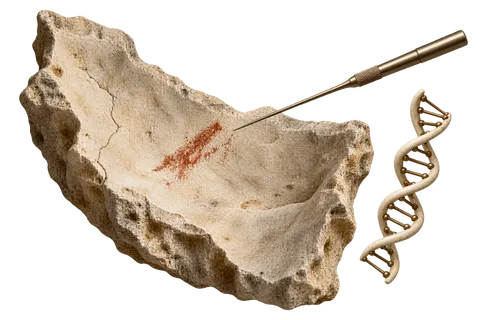
Rock art survives on walls that rarely preserve the identity of the person who made a mark. A 2026 Nature Communications study asked whether those surfaces might retain ancient human DNA. The team examined samples taken from and around 24 rock-art panels in 11 caves across Spain and Portugal. It found ancient human genetic traces in one pigmented calcite crust sample at Escoural Cave and in several unpigmented wall samples nearby. That is a methodological advance: human DNA can persist on cave-wall material. It is not, by itself, a fingerprint of the painter. Nature Communications ↗
What made the signal credible
The researchers did more than detect human sequences. They examined characteristic chemical damage at the ends of DNA molecules, compared pigmented and unpigmented surfaces, and assessed possible present-day contamination. The pigmented Escoural result appeared in two extractions from one sampled fragment, while additional subsampling did not find a broad distribution of the same signal across that panel. The study also recovered ancient human DNA from some bare-wall samples. These controls matter because a cave wall is exposed to repeated human visits, dust, water and contact over many centuries. Nature Communications ↗
The authors' key distinction
DNA on a decorated surface can have several histories. It might reflect contact by a maker, a later visitor, or material transferred from nearby sediments. In some unpigmented samples, human and animal DNA occurred together, consistent with indirect deposition. The authors explicitly state that their results do not conclusively link the recovered human DNA to the making of the rock art. They also cannot use the pigmented sample to identify an individual artist or assign the art to a particular human population. Preservation and authorship are different claims requiring different evidence. Nature Communications ↗
Why this still changes the toolkit
Until now, ancient-DNA work around painted caves has drawn mainly on bones, floor sediment or portable objects. Directly examining mineral crusts and wall material adds a spatially closer line of evidence. The technique may eventually help reconstruct patterns of contact with caves or clarify when human traces entered particular deposits. Any such inference will need careful conservation, independent dating, contamination controls and replication across panels. The most promising result is a new kind of testable question, not a solved identity mystery. Nature Communications ↗
A headline that would go too far
Saying that scientists identified the artists of Altamira or proved who painted Palaeolithic motifs would misstate this study. Its positive pigmented sample came from Escoural, and the detected DNA cannot be securely assigned to the act of painting. Future work may narrow the gap between a trace and an event, but it must also show that sampling did not damage the heritage it seeks to understand. For now, the responsible conclusion is precise: ancient human DNA can survive on cave walls, while the maker of an image remains unknown. Nature Communications ↗