A 480,000-year-old tool and the evidence in its surface
An elephant-bone fragment from Boxgrove carries microscopic traces of use. The claim is about a specific material and task, not a named maker.
A small object in a large story
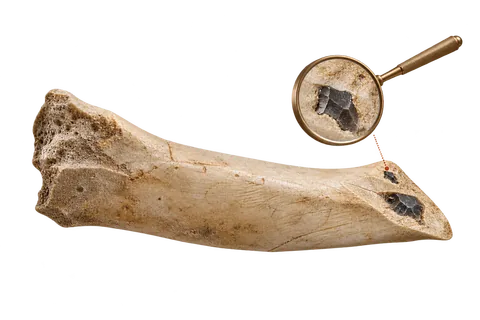
The Boxgrove site in southern England is known for finely worked Acheulean handaxes. A 2026 Science Advances paper examines a less conspicuous object from its deposits: a fragment of elephant cortical bone. The authors argue it was deliberately shaped and used as a soft hammer, or retoucher, to resharpen flint tools around 480,000 years ago. Their claim is unusually specific. It concerns a particular raw material and use, making this the earliest known elephant-bone knapping tool in Europe—not the earliest bone tool of any kind. Science Advances ↗
How use was inferred
An ancient bone fragment is not a tool simply because it looks convenient to hold. The researchers studied its shape and the distribution of pits, scores and flake scars, then used three-dimensional surface models and scanning electron microscopy to inspect fine marks. Tiny flint chips embedded in battered areas give the interpretation a material anchor: impacts against stone left traces on the bone. The convergence of shaping, repeated percussion marks and embedded material makes an intentional knapping use more persuasive than form alone. Science Advances ↗
Why choose elephant bone?
Soft hammers made from bone or antler can detach flakes differently from hard stone hammers, giving a knapper more control over a cutting edge. Elephant bone has a thick cortical layer that could withstand repeated blows. The Boxgrove specimen adds a rare material to a known toolkit of flint and organic implements. It also illustrates a preservation bias: wood, antler and many bone objects disappear more readily than stone, so the surviving handaxe assemblage is an incomplete picture of the work that produced it. University College London ↗
The limits of the claim
The artifact does not identify the individual, social group or hominin species that held it. The research team discusses possible makers for this period, but the object itself does not settle taxonomy. Its precise role is inferred from physical traces and archaeological context, not witnessed directly. Nor should a rare use of elephant bone be recast as evidence that such material was standard across Middle Pleistocene Europe. A professional account keeps the object's strong use-wear evidence separate from broader stories about who made it and how common the practice was. Science Advances ↗
A method for reading craft
The wider lesson is methodological. Archaeologists reconstruct a tool's life history by combining geological position, breakage, surface alteration and residues. Embedded flint chips are especially useful because they connect a candidate hammer to the material it may have struck. Further comparable finds would show whether elephant-bone retouchers were exceptional or part of a larger but poorly preserved repertoire. Until then, Boxgrove offers a tightly argued example of technological choice, not a license to invent the craftsman's identity. Science Advances ↗